
Heat Pump vs Furnace in Castle Rock, CO: 2026 Guide
Heat Pump or Gas Furnace in Castle Rock? Here's the Honest 2026 Answer
At 6,224 feet in Douglas County, Castle Rock winters are cold enough that this choice genuinely matters. Here's how to decide — and why more homeowners are switching to heat pumps than ever before.
📞 Call 303-219-1000 — Free EstimateCastle Rock has grown faster than almost any city in Colorado over the past decade. That means thousands of homeowners now face the same decision: when the furnace starts going — or when the central AC gives out — do you replace what you have, or make the switch to a heat pump?
It's a question we answer every week at Mini-Splits By Joseph. And the honest answer isn't always the same. Castle Rock's elevation, your existing ductwork, your utility situation, and how long you plan to stay in the home all shape which system wins for your house.
This guide breaks it down — no filler, no overselling.
Castle Rock's Climate: Why It's a Heat Pump Battleground
Castle Rock sits at 6,224 feet with a dry, semi-arid climate. Winter lows average around 12–16°F in December and January, and subzero nights — below 0°F — happen a handful of times each year. Summers hit the mid-90s.
That range matters enormously for heat pump sizing. A decade ago, most heat pumps lost meaningful capacity below 20°F, which made Douglas County winters risky. Cold-climate models have changed that calculation. Today's inverter-driven heat pumps from Bosch, Mitsubishi, Daikin, and Fujitsu are rated to operate at -13°F to -15°F — well below Castle Rock's coldest days — with backup heat strips as a secondary safeguard.
High altitude does introduce one wrinkle: thinner air means combustion furnaces need to be properly rated for elevation. It also means heat pump refrigerant systems perform slightly differently than at sea level. Both factors are accounted for in a proper load calculation — which any reputable heating and air conditioning contractor in Denver should perform before recommending a system size.
How a Gas Furnace Works in Castle Rock
A gas furnace burns natural gas to produce heat, which a heat exchanger transfers to your home's air supply. Efficiency is measured in AFUE (Annual Fuel Utilization Efficiency). Most Castle Rock homes have 80 AFUE furnaces installed 15–25 years ago; today's high-efficiency models reach 96–98 AFUE and use direct-vent combustion that's safe at altitude.
The appeal is straightforward: gas heat is dry, it heats a space quickly, and it performs regardless of outdoor temperature. For many Castle Rock homeowners on natural gas, a furnace replacement costs less up front than a heat pump system. If you have solid, well-sealed ductwork, a furnace paired with a new central AC is a sensible, predictable path.
The limitation: you're running two separate systems — one for heating, one for cooling — and you're locked into natural gas prices for the life of the equipment. If Xcel Energy continues shifting toward natural gas rate increases, your operating cost can rise year over year.
How a Heat Pump Works in Castle Rock
A heat pump moves heat rather than generating it. In winter, it extracts heat energy from outdoor air (even cold air) and moves it inside. In summer, it reverses — pulling heat from inside your home and rejecting it outdoors. One system does both jobs.
The key number is the coefficient of performance (COP). At 25°F outdoor temperature, a cold-climate heat pump delivers 2.5–3.5 BTUs of heat for every BTU of electricity consumed. That's 250–350% efficiency, far higher than any gas furnace can achieve. At 0°F, that efficiency drops — but cold-climate units maintain enough output to heat most Castle Rock homes on their own.
Xcel Energy pays a rebate of $1,500 per ton for qualifying cold-climate heat pumps, applied up front by a certified contractor like Mini-Splits By Joseph. That can reduce a whole-home system cost by $4,500–$6,000 on a typical Castle Rock two-story. See the full rebate details at our Xcel rebates page.
Castle Rock Rebate Note: Xcel Energy serves most of Castle Rock's natural gas and electric customers. If your heat pump qualifies as a cold-climate model (which any unit we install does), the $1,500/ton rebate is applied directly at time of installation — you don't file paperwork or wait for a check. Learn more about Xcel rebates →
Heat Pump vs Furnace: Side-by-Side
| Factor | Cold-Climate Heat Pump | Gas Furnace + Central AC |
|---|---|---|
| Heating efficiency | 250–350% (COP 2.5–3.5) | 80–98% AFUE |
| Operates below 0°F | Yes (with backup heat strips) | Yes |
| Up-front cost (installed) | Higher (Xcel rebates reduce gap) | Lower |
| Monthly operating cost | Usually lower on Xcel electric rates | Varies with gas prices |
| Cooling included | Yes — same unit | Needs separate AC |
| Fuel lock-in risk | Low (Xcel electric rates regulated) | Gas prices can rise |
| Requires ductwork | Yes (can also use ductless zones) | Yes |
| Avg. equipment life | 15–20 years | Furnace 20 yrs + AC 15 yrs |
What the Installation Process Looks Like
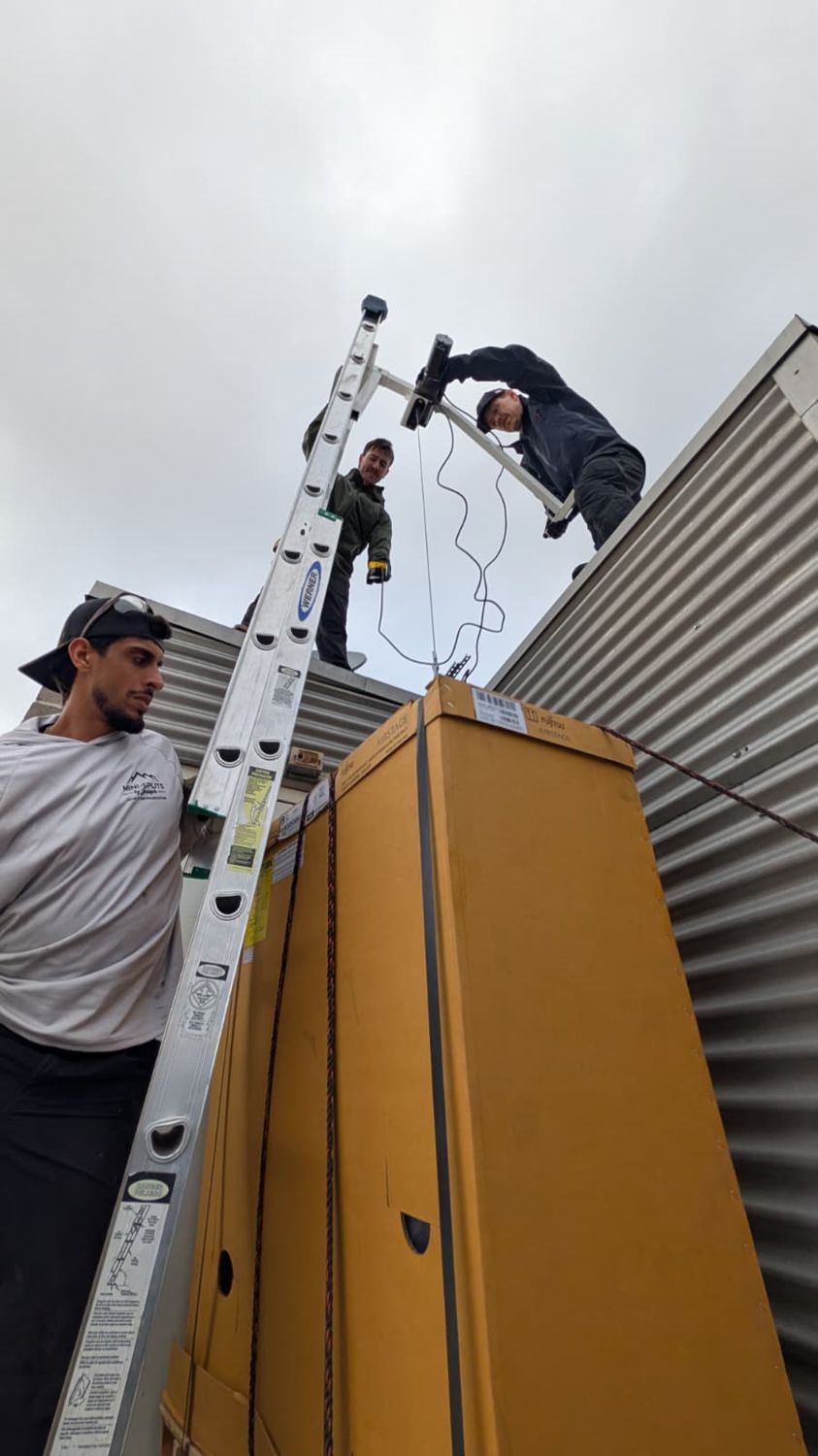
Whether you're replacing a furnace and AC with a heat pump, or upgrading a 20-year-old system, here's what to expect:
- Free in-home estimate and Manual J load calculation based on your home's square footage, insulation, windows, and Castle Rock's design temperatures.
- Equipment selection and permit filing with Douglas County. Heat pump and furnace replacements both require mechanical permits in Castle Rock.
- Ductwork inspection and sealing. Heat pumps run at lower air temperatures than furnaces — leaky ducts matter more. We seal before we commission.
- Equipment installation and refrigerant charging (heat pumps) or gas line connection and venting (furnaces). Most jobs complete in one day.
- System commissioning, thermostat programming, and walkthrough with your household so everyone knows how to use it.
When to Choose a Heat Pump in Castle Rock
A cold-climate heat pump is the right call when: your current AC is also at end of life (replacing both at once with a heat pump costs less than two separate systems); you want to insulate yourself from future natural gas price swings; your ductwork is in good shape and well-sealed; or you're planning to add ductless mini-split zones to spaces the main system can't reach (a finished basement, a sunroom, an ADU). The Xcel rebate stack makes this the most financially compelling moment in Colorado to make the switch.
When to Stick with a Gas Furnace
A furnace replacement makes sense when: your AC was recently replaced and you're only replacing the furnace; your budget is tight and you want the lowest up-front cost; or your home's ductwork is marginal and you're not ready to invest in duct sealing. In those cases, a 96 AFUE condensing furnace paired with your existing AC is a sensible, reliable option. We install both — the right system for your home, not the one with the highest margin for us.
Frequently Asked Questions
Can a heat pump really keep up in a Castle Rock winter?
Yes — today's cold-climate heat pumps from Bosch, Mitsubishi, Fujitsu, and Daikin are rated to -13°F to -15°F. Castle Rock's design temperature is typically around -3°F to 5°F depending on the specific location, so modern cold-climate units maintain substantial heating capacity even during the coldest nights. All systems include electric backup strips as a secondary stage.
How much does heat pump installation cost in Castle Rock?
A ducted whole-home heat pump system in Castle Rock typically ranges from $9,000 to $18,000 installed before rebates, depending on home size and system complexity. The Xcel Energy cold-climate rebate of $1,500 per ton reduces that significantly — a 3-ton system gets $4,500 off. We provide free estimates specific to your home's layout and load. For ductless zones, see our mini-split calculator.
Does Douglas County require a permit for HVAC replacement?
Yes. Both heat pump and furnace/AC replacements require a mechanical permit in Castle Rock. We handle the permit filing as part of every installation — you don't need to do anything separately. The inspection process typically adds one business day to the project timeline.
Can I add mini-split zones to supplement a central system?
Absolutely — and it's one of the most effective approaches for Castle Rock homes with problem areas. A central heat pump handles your main living spaces through ductwork, while one or two ductless mini-split zones solve the basement, home office, or bonus room over the garage. Both systems run on Xcel electricity and qualify for rebates independently.
Ready to Decide? Get a Free Castle Rock Estimate
We'll assess your home, run a proper load calculation, and give you honest numbers for both a heat pump and a furnace replacement — so you can make the right call for your budget and comfort goals.
Request a Free Estimate📞 303-219-1000