
Tesla Powerwall vs Generator in Thornton, CO: Home Backup Guide
Tesla Powerwall vs. Standby Generator: The Thornton Homeowner's Backup Power Guide
Thornton summers bring fast-moving storms and Xcel grid stress events. Here's how to choose between a Tesla Powerwall home battery and a standby generator — and which makes more sense for your home.
📞 Call 303-219-1000 for a Free EstimateThornton ranks among Colorado's fastest-growing cities — and its residents are increasingly aware of how quickly a summer thunderstorm can knock out power for an afternoon, or a winter ice storm can darken a neighborhood overnight. For homeowners running heat pumps, keeping a freezer stocked, or relying on a well pump, an outage isn't just an inconvenience. It's a genuine problem.
Two technologies solve it: the Tesla Powerwall home battery backup and the traditional standby generator. They work differently, cost differently, and suit different households. This guide walks through both so you can make a clear-eyed decision for your Adams County home.
Why Thornton Homeowners Are Rethinking Backup Power
Thornton sits at roughly 5,350 feet in Adams County, where afternoon thunderstorms build quickly off the Rockies and can trip distribution lines for hours at a stretch. The city has grown faster than much of the metro, and that growth has put stress on local grid infrastructure during peak summer demand. In winter, a heavy snow or ice event can cause multi-hour outages across the northern suburbs.
Add in the growing number of all-electric homes — running cold-climate heat pumps instead of gas furnaces, and heat pump water heaters instead of gas tanks — and the stakes of losing power rise sharply. No grid power means no heating on a Colorado January night, no hot water, and potentially frozen pipes in an older Adams County home.
Backup power used to mean a noisy, portable gas generator you'd drag out of the garage. Today, Thornton homeowners have two serious, permanently installed options worth comparing.
How the Tesla Powerwall Works
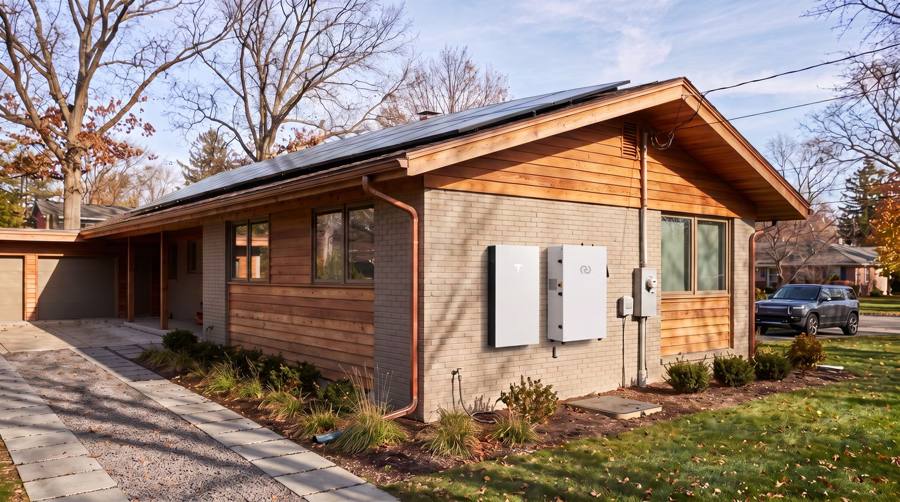
The Tesla Powerwall 3 is a wall-mounted lithium-iron phosphate battery that charges from the grid (or from solar panels, if you have them) and releases that stored energy automatically the moment Xcel's grid drops. A single unit holds 13.5 kWh of usable capacity and can power essential circuits — lighting, refrigerator, phone charging, and a single-zone ductless mini-split — for 6 to 12 hours depending on your load.
The Powerwall connects to a Backup Gateway that monitors the grid continuously and switches your home to battery in milliseconds — so fast that most electronics don't even notice the transition. Two Powerwalls stacked together extend that reserve to cover most 12–24 hour events. Because the battery recharges from the grid automatically, you don't have to manage fuel or schedule maintenance.
The Powerwall also participates in Xcel Energy's time-of-use billing: it can charge overnight at lower off-peak rates and discharge during expensive peak hours, trimming your monthly bill even when the grid stays on. Learn more about our Tesla Powerwall installation services in Denver and Thornton.
How a Standby Generator Works
A propane or natural-gas standby generator is a permanently installed appliance that sits outside your home on a concrete pad. It starts automatically within 10–30 seconds of a grid failure and can run as long as there's fuel — making it the right call for extended outages after major weather events.
Whole-home units sized for a typical Thornton house typically run at 20–22 kW — enough to power a furnace or heat pump, water heater, kitchen appliances, and all your lighting simultaneously. The trade-offs are noise (they sound like a lawn mower running), annual maintenance (oil, air filter, fuel management), and the need for either a propane tank on your property or a natural gas line connection. In Thornton, HOA guidelines in newer subdivisions may restrict placement and require noise screening.
Generators shine in rural and foothills scenarios where outages can last days. For most Thornton neighborhoods, the typical outage window falls well within what a battery system can cover. That said, pairing a Powerwall with a backup generator gives you the best of both: silent, instant battery coverage for short events, with the generator available for extended emergencies. Our team also installs standby generator systems across the Denver metro for homeowners who need that extended-run security.
Powerwall vs. Generator: Side-by-Side for Colorado Homes
| Feature | Tesla Powerwall | Standby Generator |
|---|---|---|
| Response time | Milliseconds (seamless) | 10–30 seconds |
| Run time | 6–24 hours per charge | Unlimited (while fuel lasts) |
| Noise | Completely silent | Engine noise (~65–70 dB) |
| Maintenance | None required | Annual tune-up + fuel management |
| Emissions | Zero | CO and exhaust (outdoor only) |
| HOA compatibility | Discreet wall mount | Requires placement approval |
| Heat pump pairing | Excellent (efficient load) | Yes, with adequate kW rating |
| Self-recharging | Yes (from grid or solar) | No — requires manual refueling |

What Powerwall Installation Looks Like in Thornton
Installing a Tesla Powerwall in a Thornton home is a one-to-two-day project. The unit mounts to an exterior wall or inside an attached garage close to your main electrical panel. We also install the Tesla Backup Gateway 2, which handles the automatic grid-to-battery switchover and provides monitoring through the Tesla app. In most cases, we configure a backed-up load panel covering your essential circuits.
- Site assessment and panel evaluation — we check your existing panel capacity and determine if a sub-panel is needed for essential circuits.
- Permit application to Thornton Building and Inspection Services — we handle all paperwork and coordinate the inspection.
- Physical installation — Powerwall mounted, gateway wired, backed-up sub-panel connected.
- Tesla app setup and walkthrough — you'll see your energy flow in real time before we leave the job.
If you're adding a heat pump at the same time, we coordinate the panel sizing for both projects from day one. Schedule your Powerwall consultation and we'll walk through the full scope together.
Frequently Asked Questions
How long does a Tesla Powerwall last during a Thornton power outage?
A single Powerwall 3 (13.5 kWh) running essential loads — refrigerator, lighting, phone charging, and one mini-split zone — typically lasts 6 to 12 hours. Two units together cover most 24-hour events. If an outage runs longer, solar panels or a generator provide the recharging source.
Does a Tesla Powerwall work with my heat pump or mini-split?
Yes. The Powerwall outputs standard 120V/240V power, so your heat pump or ductless mini-split runs exactly the same on battery as it does on the grid. A single-zone mini-split is a light, efficient load. A large multi-zone system draws more, but two Powerwalls can handle most overnight outages.
Do I need a permit to install a Powerwall in Thornton, CO?
Yes — Thornton's Building and Inspection Services division requires an electrical permit for home battery installations. We manage the permit application, the inspection, and all required documentation as part of every job.
Can I start with one Powerwall and add a second later?
Yes. Tesla's system is fully stackable. Many Thornton homeowners install one Powerwall first, observe their usage patterns, and add a second unit within a year or two. We design the initial install with expansion in mind.
Ready to Protect Your Thornton Home?
We install Tesla Powerwall home batteries and standby generators across Thornton, Adams County, and the Denver metro. Get a free estimate — no pressure, just honest answers.
📞 Call 303-219-1000 Request a Free Estimate →Our Services
- Heat Pump & Mini-Split Installation
- Heating & Air Conditioning (Furnaces, Central AC, Boilers)
- Mechanical Contractor / Commercial HVAC
- Walk-In Cooler & Freezer Installation
- Backup & Standby Generator Installation
- Tesla Powerwall / Home Battery Backup
- Electrical Services & Panel Upgrades
- Water Heater Installation